Case study · esports broadcast
League of Legends World Championship Final 2025
Ross Williams joined the 2025 League of Legends World Championship Final in Chengdu, China, as Floor LD, supporting lighting designers Al Gurdon and Harry Forster in delivering a large-scale esports spectacular for one of the most watched competitive gaming events in the world.
Project details
- Project
- League of Legends World Championship Final 2025
- Location
- Dong’an Lake Sports Park Indoor Gymnasium, Chengdu, China
- Production type
- Live esports world final / global broadcast / opening ceremony / trophy ceremony
- Creative Director / Co-Director
- Anyma
- Executive Producer / Creative Studio
- Done+Dusted
- Creative & Executive Producer
- Jay Revell
- Director
- Hamish Hamilton
- Lighting Designers
- Al Gurdon / Harry Forster
- Floor LD
- Ross Williams
- Lighting Programmers
- Alex Mildenhall / Charlie Winter
- Key elements
- Floor lighting direction, key light balancing, followspot colour and level matching, press and media lighting, FOH livestreaming areas, backstage lighting, opening ceremony performances, match lighting, closing trophy and medal ceremony
Key contribution
For the 2025 League of Legends World Championship Final, Ross Williams took on a technical and creative assistant role as Floor LD, working directly to support lighting designers Al Gurdon and Harry Forster in delivering their vision for the show.
This was not a conventional lighting operator role. Ross was positioned on the floor to help make the lighting design work in the real physical environment, acting as a link between the designers, programmers, followspot teams, camera requirements, performance areas and broadcast spaces.
His responsibilities covered the lighting of press, media, FOH livestreaming and backstage areas, as well as assisting the programming team with key light balance, followspot levels and colour temperatures for the opening ceremony performances, the matches and the closing trophy and medal ceremony.
The role required Ross to understand not only what the designers wanted the show to look like, but also how the programmers were building that look behind the console.
Project overview
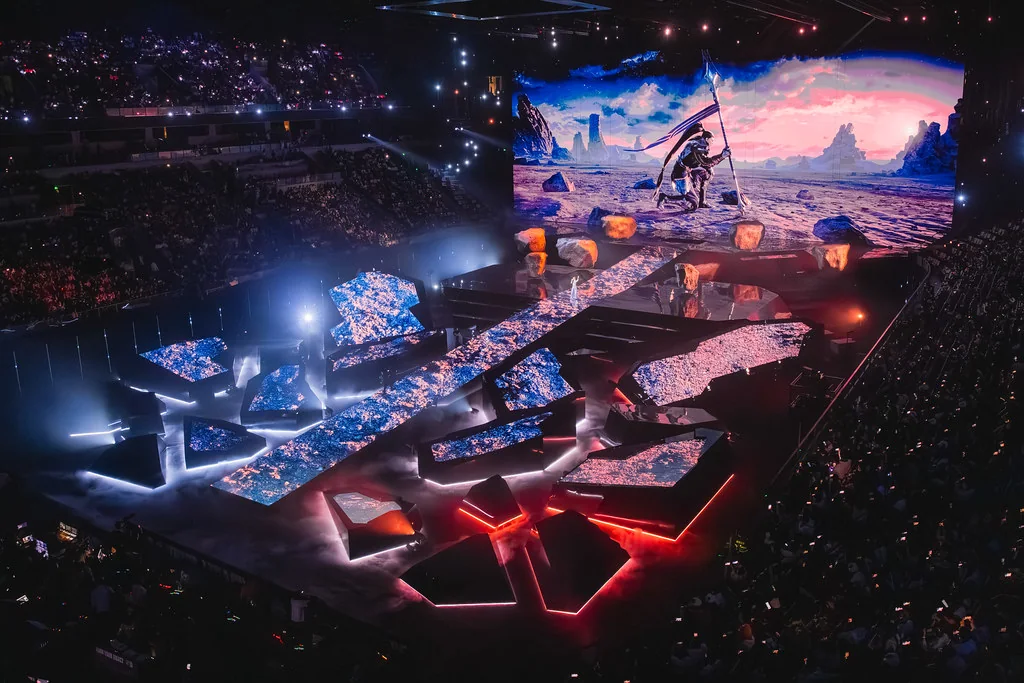
The League of Legends World Championship Final is one of the biggest events in global esports, combining elite competitive gaming with a large-scale live opening ceremony, theatrical performance, broadcast storytelling and a final trophy moment watched by millions around the world.
The 2025 final in Chengdu required the lighting design to support several very different demands within one show environment. It had to deliver the scale and energy of the opening ceremony, the clarity and competitive focus of the matches, the emotional weight of the trophy presentation, and the practical requirements of press, media, backstage and livestreaming areas.
For Ross, the challenge was to help maintain consistency and control across all of these spaces, while supporting the creative intent of Al Gurdon and Harry Forster.
The role of Floor LD
Ross’s role as Floor LD was centred on observation, measurement, communication and adjustment.
Working from the show floor gave him a direct understanding of how the lighting behaved in the venue, how it read on performers and players, and how the design translated from the console to the physical stage. This position allowed him to assist the designers and programmers with accurate, practical feedback throughout the rehearsal and programming process.
Ross helped oversee lighting across the press and media environments, FOH livestreaming positions and backstage areas, ensuring those spaces were usable, balanced and appropriate for camera. These areas are often less visible to the main audience than the arena stage, but they are essential to the overall broadcast and event experience.
At the same time, Ross supported the main show lighting by assisting the programmers, particularly Charlie Winter on the key light desk. This involved helping set balanced key light levels and colour temperatures across the rig and followspots for the opening ceremony performances, match play and the closing trophy and medal ceremony.
Key light, colour temperature and followspot balance
A central part of Ross’s work was helping ensure that the people at the heart of the show were lit consistently and appropriately.
That included performers in the opening ceremony, players during the matches, presenters, trophy ceremony participants and other key on-camera moments. Each required a slightly different lighting treatment, but all needed to sit within the same overall design language.
Ross took numerous light meter readings across the rehearsal and show period, helping the lighting team understand the balance between rig sources, followspots, scenic light, video contribution and camera exposure. This measurement process was essential in a production environment where the lighting had to support both a spectacular live arena experience and a precise global broadcast image.
Colour temperature was equally important. Followspots, key lights, video content and scenic sources all needed to work together rather than compete. Ross assisted in matching and tracking these values so that performers, players and ceremony moments remained clean, readable and visually consistent on camera.
Tracking focus and fixture use
The complexity of the show meant that the team needed to know not only which lights were available, but which lights were being used for each focus and each moment.
Ross helped keep track of which fixtures and followspots were assigned to specific focuses throughout the show. This was particularly important across an event that moved between opening ceremony performances, gameplay, broadcast positions, press requirements and the closing trophy sequence.
This kind of tracking is a detailed but vital part of making a large lighting system reliable. It helps protect consistency, avoids conflicts between cues and gives the programmers and designers confidence that the rig is being used in the way the design requires.
For a show with multiple environments and changing priorities, that information becomes part of the creative infrastructure.
Supporting the designers’ vision
The success of the role depended on Ross understanding the design intent behind the lighting, not just the technical instructions.
Working with Al Gurdon and Harry Forster, Ross needed to interpret what the designers were trying to achieve and then help the programming and floor process support that goal. This required sensitivity to the look of the show, awareness of camera and broadcast requirements, and an understanding of how decisions made on the floor would affect the console workflow.
It was a role built around trust. Ross was not there to impose a separate design language, but to help protect and deliver the one created by the lighting designers. His work helped turn their vision into a practical, measurable and repeatable system across the venue.
Collaboration with programming
Ross’s work was closely connected to the programming process.
By assisting the programmers, especially Charlie Winter on the key light desk, Ross helped provide the floor-level information needed to make programming decisions faster and more accurately. Light meter readings, focus tracking, followspot information and visual feedback all helped the console team refine levels, balance sources and build cues that would work under show conditions.
This was a different kind of collaboration from sitting behind a lighting desk. Ross had to understand the programmer’s process, the language of the console, the timing of updates and the kind of information that was useful in the moment.
That made the Floor LD role a technical bridge between the physical stage and the programmed show file.
A different kind of lighting role
This was a role Ross had not typically undertaken before, but it drew on many of the skills developed across his wider lighting career.
It required the eye of a lighting director, the discipline of a programmer, the calm of a live broadcast operator and the communication skills of a production collaborator. The work was practical, detailed and often behind the scenes, but it was essential to the consistency and reliability of the finished show.
For Ross, the League of Legends World Championship Final demonstrated the value of a lighting professional who can support a design at system level: understanding the creative goal, reading the room, measuring the result, communicating clearly and helping the team make the show work.
Outcome
The 2025 League of Legends World Championship Final brought together competition, ceremony, performance and broadcast spectacle on a global scale.
Ross Williams’ contribution as Floor LD helped support the lighting design from the ground up. By overseeing supporting broadcast spaces, assisting with key light levels and colour temperatures, tracking focus use and providing practical floor-level feedback to the programming team, Ross helped ensure the lighting system remained balanced, organised and aligned with the designers’ vision.
The role showed Ross in a different but highly valuable capacity: not only as someone who can design or operate lighting, but as someone who can help a major international live production function with clarity, accuracy and creative discipline.
Planning a similar live broadcast or esports production?
Contact Ross Williams for availability and to discuss floor lighting direction, broadcast key-light support, followspot balancing, lighting programming or collaborative show delivery.
Contact Ross