Case study
Battle Camp
Ross Williams’ lighting design for Netflix reality competition series Battle Camp, filmed in Mexico and winner of the 2025 Profile Award for Non Scripted Entertainment.
Project details
- Project
- Battle Camp
- Platform
- Netflix
- Production type
- Reality competition series
- Filming location
- Mexico
- Production company
- Thames, a Fremantle label
- Executive Producers
- Louise Peet and Ashley Whitehouse
- Production Designer
- Mathieu Weekes
- Lighting Designer
- Ross Williams
- Director of Photography
- Andrew Allen
- Gaffers
- Matt Chalk and Aaron Jones
- Award
- 2025 Profile Award — Non Scripted Entertainment Award
- Award recipients
- Ross Williams, Andrew Allen and Matt Chalk
Key contribution
Ross designed the lighting for a remote, large-scale reality competition environment that had to feel like a natural outdoor summer camp while also delivering high-impact studio-style eviction sequences. His work balanced the competing requirements of PSC and fixed-rig filming, natural daylight control, night-time multi-camera coverage and the practical realities of lighting a fully fabricated camp set in a challenging Mexican location.
Project overview
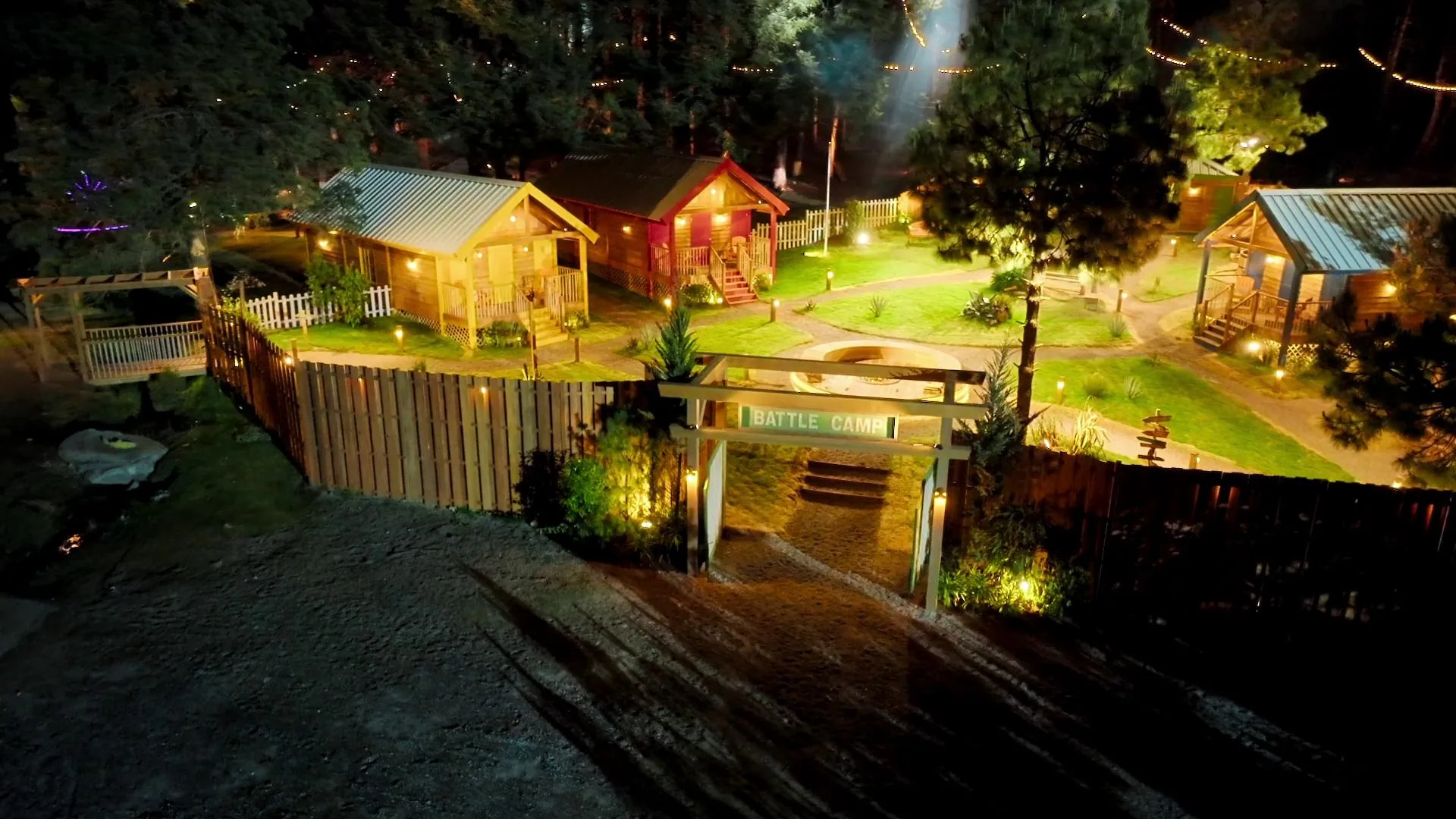
Netflix’s Battle Camp brought together stars from across the Netflix Reality Universe for a high-stakes outdoor competition series filmed on location in Mexico. Set in a remote summer-camp environment, the show combined physical challenges, punishments, social gameplay and dramatic elimination sequences, with contestants fighting to stay off the Wheel of Misfortune and win the $250,000 prize.
Ross Williams was Lighting Designer for the series, designing a lighting approach that had to support two very different visual worlds. For most of the show, the brief was to make the camp feel natural, warm and believable — a sunlit outdoor summer camp where the lighting felt motivated by the environment rather than imposed on it. But when the show moved into eviction sequences, the tone shifted completely, requiring a full studio light-entertainment treatment with drama, contrast, colour and scale.
Lighting the camp environment
That duality became one of the defining challenges of the project. By day, the lighting team were either creating sunlight that did not exist or controlling too much of it with reflectors, scrims, bounce cloths and careful camera-led shaping. By night, the production needed to support a huge fixed-rig reality setup, including dozens of remote cameras, while still preserving the naturalistic feel of a real camp environment.
The location added another layer of difficulty. The camp was built from scratch on the edge of a mountain reservoir in Mexico, with no existing lighting infrastructure to rely on. Everything seen on screen across the cabins, camp areas, challenge zones and interview spaces had to be designed, shipped, installed and integrated specifically for the production. The environment was remote, physically demanding and technically unforgiving, with the crew also working at altitude.
Technical challenges
A key challenge was that the lighting team were effectively lighting two shows at once. The PSC camera team, working with highly sensitive camera equipment, could operate at very low light levels and often wanted a softer, more natural look. The fixed-rig team, working with approximately 60–70 remote hot-head cameras, needed far more light outside the brightest daylight hours. Both systems filmed simultaneously, often with one unit’s background appearing in the other’s shot, meaning the lighting had to serve multiple technical and creative needs at the same time.
Although the series ultimately went through an edit, strict night-time curfews for security reasons meant that most filming after dark — apart from overnight fixed-rig camp coverage — had to be captured multi-camera and close to as-live. This placed heavy demands on the lighting design, which needed to be robust, repeatable and ready to support unfolding reality action with limited opportunity to reset.
Production workflow
Ross designed the rig, specified the lighting equipment and crew, and led the overall lighting approach for the series. Director of Photography Andrew Allen worked closely from the PSC camera side and was instrumental in shaping many of the outdoor daytime setups. Gaffer Matt Chalk was central to making the design work practically on location, helping the team deliver the scale, flexibility and quality needed across the camp, challenge areas and night sequences. Aaron Jones also worked as gaffer on the production.
The result was a visually ambitious non-scripted series where the boundary between real environment and constructed set was deliberately blurred. The interview room, cabins, camp areas and exterior locations were designed to feel as though they belonged to one coherent world, even though much of what appeared natural on screen had been carefully built, rigged and lit for television.
Recognition
Ross’s work on Battle Camp, alongside Andrew Allen and Matt Chalk, was recognised with the 2025 Profile Award for Non Scripted Entertainment.
Planning a similar production?
Contact Ross Williams for availability and to discuss lighting design, broadcast lighting control or selected lighting director roles.
Contact Ross